You can walk from your own body back to a mouse in ten steps. Not ten million steps. Ten.
Richard Dawkins built The Ancestor’s Tale as a pilgrimage that runs the wrong way down time. You set out from the present and walk backward, and every so often another kind of animal comes up the road and falls in beside you — not because it descends from you, but because you and it both descend from someone, and this is the place where that someone was alive. Dawkins calls the meeting a rendezvous, and the ancestor waiting at it a concestor: the most recent ancestor the two of you have in common.
From a human being to a mouse is ten of them.
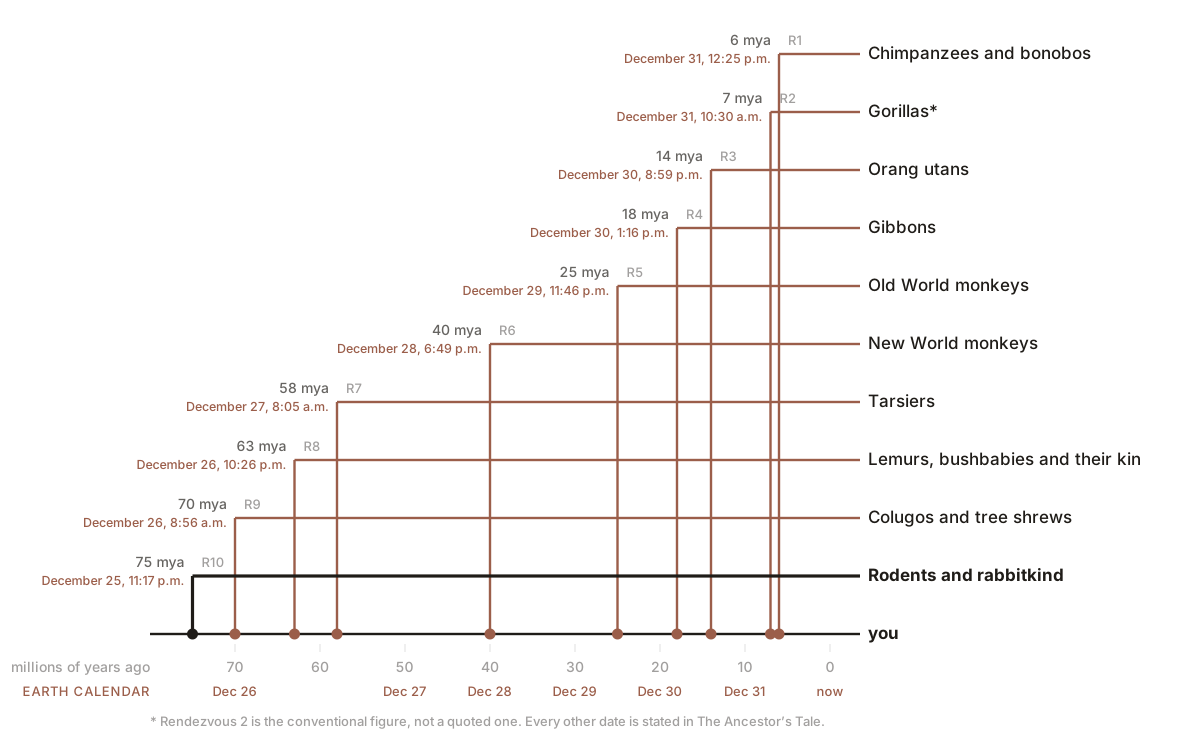
Look at what the calendar does to that list. The whole walk — all ten meetings, all seventy-five million years — is the last six days of December. The mouse is the evening of Christmas Day. Everything else on this page happens in the week after it.
All ten
Here is every rung, in order, walking backward. Several of them barely differ from the one before — the first four are all apes, the last two are both small and shrew-like — and that is not a weakness in the drawings. It is the whole point. Nowhere along this road does one kind of animal turn into another. There is only the next one, slightly changed, and then the next.
Nobody has the skeleton of any of these animals. Where Dawkins describes an ancestor, the drawing follows what he says. Where he does not, it follows the rule he uses throughout the book — that an ancestor most likely had the features its descendants share — and the text below says so plainly.
6 million years ago · December 31, 12:25 p.m.
Rendezvous 1 — chimpanzees and bonobos

The first animal to join you is not a chimpanzee, and the ancestor you meet is not one either. But Dawkins’s prudent answer is that Concestor 1 was more like a chimpanzee than like us, and the reason is worth holding onto: chimpanzees are more like the rest of the apes than we are. We are the odd ones out. More has changed along our line since the split than along theirs.
Which is not the same as saying we are descended from chimpanzees. We are not, and Dawkins takes the trouble to say so.
7 million years ago · December 31, 10:30 a.m.
Rendezvous 2 — gorillas

Two hours earlier on the same calendar day, the gorillas. Dawkins guesses this one also looked more like a chimpanzee than a gorilla, for a plain reason: the huge gorilla is the extreme case, less like apes in general. He thinks it was a knuckle-walker too, and that like chimpanzees it spent time up trees as well, especially at night.
It is roughly your three-hundred-thousand-greats-grandparent.
14 million years ago · December 30, 8:59 p.m.
Rendezvous 3 — orang utans

This is the last ancestor shared by the orang utans and every African ape, ourselves included, so as Dawkins says, it might resemble either or both of them. He also argues it probably lived in Asia rather than Africa — a conclusion that arrives by a long detour through sea levels and submerged land bridges.
18 million years ago · December 30, 1:16 p.m.
Rendezvous 4 — gibbons

Smaller than the last one, and more committed to the trees. Dawkins suspects it hung and swung from its arms, though with arms not yet as long or as specialized as a modern gibbon’s. A gibbon-like face, he thinks, with a short snout.
And no tail. Hold onto that, because one rung further back there is a tail.
25 million years ago · December 29, 11:46 p.m.
Rendezvous 5 — Old World monkeys

Seven million years further back, the baboons and the macaques join the road. Dawkins guesses this ancestor was perhaps a little like the fossil genus Aegyptopithecus, and reasons out the rest the way he reasons about all of them: it most likely had the features its descendants share. Narrow nostrils, facing downward. A bony ear tube.
And a tail. Concestor 5 was presumably tailed, like nearly every other mammal, and Concestor 4 — one rung nearer the present — was tailless, like every ape after it. So the tail was lost somewhere on the road between these two drawings, and, as Dawkins says plainly, we do not know where. It is not the boundary between monkey and ape. There is no such boundary. There is only a stretch of road with a tail at one end of it and none at the other.
40 million years ago · December 28, 6:49 p.m.
Rendezvous 6 — New World monkeys

The monkeys of South and Central America join here, which means this is the last ancestor of every monkey and every ape alive. The book does not stop to describe the animal itself, so this drawing is the rule of thumb and nothing more: small, in the trees, with the features its descendants have in common.
58 million years ago · December 27, 8:05 a.m.
Rendezvous 7 — tarsiers

Something like an omomyid, Dawkins says, and the omomyids were quite tarsier-like — their eyes not so enormous as a modern tarsier’s, but big enough to say they hunted at night. His guess is that this ancestor was a daylight version of one, living in the trees. Your six-million-greats-grandparent.
63 million years ago · December 26, 10:26 p.m.
Rendezvous 8 — lemurs, bushbabies and their kin

Here the last of the primates joins, and the animal waiting is the most recent ancestor shared by every primate now alive — every lemur, every monkey, every ape, and you. Dawkins puts it in the branches of a tree, after fruit or maybe an insect. He also counts the generations, which is the sort of thing that stops a reader mid-page: this is approximately your seven-million-greats-grandparent.
The dinosaurs had been gone two and a half million years. Both events fall on December 26 — the asteroid at about five thirty in the evening, this ancestor at ten thirty the same night.
70 million years ago · December 26, 8:56 a.m.
Rendezvous 9 — colugos and tree shrews

This is the least settled rung on the walk, and Dawkins says so rather than smoothing it over. He provisionally accepts that the colugos and the tree shrews arrive together, as a band already joined to each other — but a few years earlier the tree shrews would have come alone, and some researchers place the colugos closer to us than the tree shrews are. The book does not describe the animal, so again this drawing is the rule of thumb.
The lesson he draws from the disagreement is not that the science is shaky. It is that this is what an honest answer looks like while it is still being worked out.
75 million years ago · December 25, 11:17 p.m.
Rendezvous 10 — rodents and rabbitkind

And then the road fills up. Rats, mice, squirrels, beavers, porcupines, rabbits, hares and pikas — by weight of numbers the largest crowd to join at any point on this walk.
The animal waiting for them, and for you, is your fifteen-million-greats-grandparent. It is the most recent ancestor you share with a mouse. It was small and shrew-like, because in those days every mammal was small and shrew-like, whether its descendants were bound to become mice or hippos. There were still dinosaurs.
It is drawn above from a description, not from a skeleton. What is not guesswork is the relationship.
The other line
Everything above walks in one direction: back from you, to that animal. Drawn only that way it becomes your ancestor, which a mouse is somehow also related to — and that is not what it is. It is the mouse’s ancestor in exactly the same sense, and to exactly the same degree.
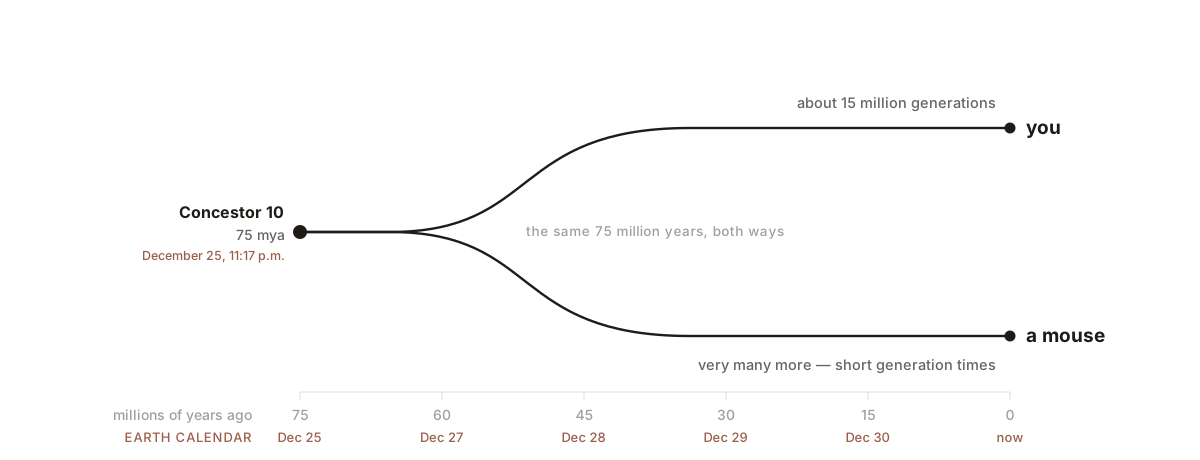
So turn around at the concestor and walk forward instead. Two lines leave it. Both arrive here.
Dawkins puts the difference in a single sentence, and it is easy to read past:
Concestor 10 is approximately our 15-million-greats-grandparent. It is the latest ancestor we share with a mouse, but the mouse is connected to it through a very much larger number of greats, because of short generation times.
The same span of years. Roughly fifteen million generations along our side of the fork — and far more than that along the mouse’s, because a mouse gets on with it. The book does not put a number on the mouse’s side, and neither does the diagram.
Which means the walk you have just taken has a twin. Somewhere on the other branch there is a mouse’s version of this page, with its own ten rungs and its own drawings, and at the far end of it there is us — joining the road at a rendezvous, in the evening, on Christmas Day.