These are not eleven separate things. They are one family.
The first drawing is the ancestor of the ten below it, and of you. That is not a figure of speech and not a way of being nice about nature. Everything alive descends from that cell — which means the octopus is a relative, and so is the thread under the forest floor, and so was the animal in the last drawing.
They are grouped here by where they ended up: the sea, the air, the land. Each group opens with a line — the run of ancestors going back from one animal that is alive right now.
Read the lines first. They are the part that matters, and they are also the part that is easy to get wrong: a list of animals on a page invites you to draw a chain through all of them, and there is no chain. Under each line is a note saying who else lives in that place and is not on it.
Dates are the Earth Calendar, the planet’s whole history pressed into one year. Nothing here is a step toward anything else. A bacterium is not a rough draft of a cat, and a family tree is not a ladder.
Before any of it
4.2 billion years ago · January 28
LUCA

Read the name carefully, because two of its words do work that is easy to miss. It stands for the Last Universal Common Ancestor.
Last, not first. There was life before her, possibly a great deal of it, with relatives and neighbors and competitors, and every one of those lineages ended without leaving anyone behind. She is not the root of life. She is the root of the surviving part, which is a humbler and sadder thing to be.
And ancestor in the way a population is an ancestor. It is convenient to say one cell, and you will see it written that way, and it is close enough to be forgivable — but what the evidence supports is an ancestral community, trading genes with one another, which makes a single individual at the base of the tree a simplification rather than a finding.
What is not a simplification is the relationship. Every other drawing on this page is descended from this one.
The sea
The line, running back from an animal alive right now:
- Now Octopus
- — molluscs. Its nearest relatives are snails.
- ~600 Ma · Nov 13 a small nerve-bearing animal in a Precambrian sea — our last common ancestor with it, and yours
Also in the sea, and not on that line: the cyanobacteria, which are bacteria and sit on a branch that left ours long before there were animals; and Tiktaalik, who is on the land animals’ line, on his way out of the water.
Earth Calendar — June 21 to July 22
Cyanobacteria

They worked out how to run on sunlight and water. The by-product was poison.
Oxygen is not something the world was given. It was waste. For a long stretch afterward nothing much happened to the air, because the oxygen was being absorbed as fast as it was made — it reacted with iron dissolved in the sea and came out of the water as rust, and it settled, layer on layer, for hundreds of millions of years. You can still see this. There are cliffs on several continents striped red and gray in bands you could count like tree rings.
Then the sinks filled, and the air turned, and a great deal of what was alive at the time could not live in what the air had become.
Effectively every molecule of oxygen you have ever breathed was made by something living. And these are not a chapter that closed: cyanobacteria are still here, in the sea and in the puddle at the end of your street, doing the same job.
Earth Calendar — November 13, and every day since
Octopus

Its nearest relatives are snails.
Most of its neurons are not in its head. They are distributed down the arms — which means an arm is not simply being told what to do. Some of the deciding happens out there, at a distance from anything we would call a brain.
Our last common ancestor with it was a small nerve-bearing thing in a Precambrian sea, which makes the octopus about the farthest away from us that anything can get and still be something anyone would call a mind.
What it is like to be one may be a question we are not built to receive the answer to. Some questions in this book are like that, and saying so is not a retreat.
About 375 million years ago · December 1
Tiktaalik

A fish with a neck.
That is the part to hold onto. Fish do not have necks — the head is locked to the shoulder, and to look sideways a fish turns its whole body. This one could turn its head. It had a shoulder, and inside the fin, the beginnings of the same arrangement of bones you are using to hold whatever you are reading this on.
It is not your ancestor, and the people who found it do not claim it is. It is a cousin, standing near the road rather than on it, which is the most any single fossil can honestly be. What it shows is not a moment of transition. It is that the parts were already there, in the water, being used for something else.
The air
The line, running back from an animal alive right now:
- Now Hummingbird
- ~22 Ma · Dec 30 hummingbirds as a group
- — birds
- ~66 Ma+ · Dec 26 theropod dinosaurs — the group Tyrannosaurus belongs to. Birds did not descend from him; they and he are the same branch, and she is the part of it that lived.
- ~230 Ma · Dec 13 the first dinosaurs
- — archosaurs, and back into the water from there
Also in the air, and not on that line: the pterosaur. Flight was invented more than once, by animals that were not closely related, and his version of it left nobody behind.
68 million years ago · December 26, 12:48 in the afternoon
Pterosaur

Every pterosaur lineage on Earth ended. Not reduced — ended. There is no descendant, anywhere, of anything that flew that way. The whole two-hundred-million-year experiment of flying on a membrane stretched from one enormous finger stopped, and has never been tried again.
He rode the air over a continent whose air had stopped doing what it did. Whatever he had been reaching down for in the shallows was no longer there.
An animal that big cannot hide, cannot burrow, cannot wait, and cannot live on very little. Everything remarkable about him depended on there being a great deal of world underneath him.
66 million years ago · December 26, 4:39 in the afternoon
Tyrannosaurus

He is on this page, and in this group, for two reasons.
The first is that he is a relative of the hummingbird and not of the cat. He walked on land, which is where people file him, and it is the wrong drawer — his branch is the one that got into the air and is still in it. Every bird outside your window is a dinosaur that made it.
The second is that he is the clearest possible answer to the thing people believe evolution says. When the rock came down, being enormous and armed and at the top of everything was not an advantage. It was close to a disqualification. On land, essentially nothing much above twenty-five kilograms came through — and no lineage of dinosaur except the birds came through at all.
Fittest never meant strongest. It meant matched, the way a key is matched to a lock, and the world he was matched to stopped existing inside a single afternoon of the calendar year. That is a field note of its own.
About 22 million years ago · December 30, and every day since
Hummingbird

It weighs almost nothing. It drinks the sugar a plant made out of sunlight, burns it in the muscles of its wings, and beats those wings fast enough to hold itself motionless in open air — the body hanging there, the wings gone into a blur.
Most living things run on fuel they put away days ago. This one runs on what it drank minutes ago, burning it almost as fast as it arrives. Nothing is stored in between.
The sun, the leaf, the flower, the wing — and no gap anywhere along it.
The land
The line, running back from an animal alive right now:
- Now Bezouli, a cat
- — carnivorans
- — the early mammals — small, nocturnal, alive alongside the dinosaurs and never on their way to becoming one
- ~320 Ma · Dec 6 synapsids. This is where his line and the hummingbird’s part company — ninety million years before the first dinosaur existed.
- ~375 Ma · Dec 1 a lobe-finned fish coming out of the water, of the kind Tiktaalik stood beside
Also on the land, and not on that line: the mycelium, the tree and the jumping spider. The land was not colonized once. Plants, fungi and animals each made the crossing separately, out of the same water, and none of them was following the others.
Earth Calendar — November 23, and every day since
Mycelium

A mushroom is not the organism. It is the fruiting body — the part that comes up to let spores go. The organism is the threads, and the threads are underneath you.
Fungi are not plants. They are closer to us than they are to the tree they are wrapped around, which is one of those facts that sounds like a trick and is not.
So a forest is not a collection of trees standing near each other in the same weather. It is a single continuous physical fabric, in which the trees are the visible parts and the connective tissue is underground and alive.
And the fabric is doing work. If you have ever wondered what keeps a wooded slope on the slope, this is most of the answer. Take the threads out and the soil goes down the hill.
About 470 million years ago · November 24
A tree

Knock on it. Where did all that weight come from?
Nearly everyone says the soil, and educated people said so for two thousand years, and it is wrong. Almost all of it came out of the air. The carbon was carbon dioxide, the hydrogen was water, and the mineral fraction taken from the ground is small enough to be a rounding error. The thing you are knocking on used to be a gas. There is a field note on this.
Plants came ashore around here on the calendar, and the drawing above this one is part of why they could. The roots in this picture are not working alone. Some of the earliest fossils of plants on land already have fungal threads inside their tissue — the partnership is not something the two of them arrived at later, it is nearly as old as being on land at all.
Trees themselves come a week further on, on December 1. Everything before that was low.
Now
Peacock spider
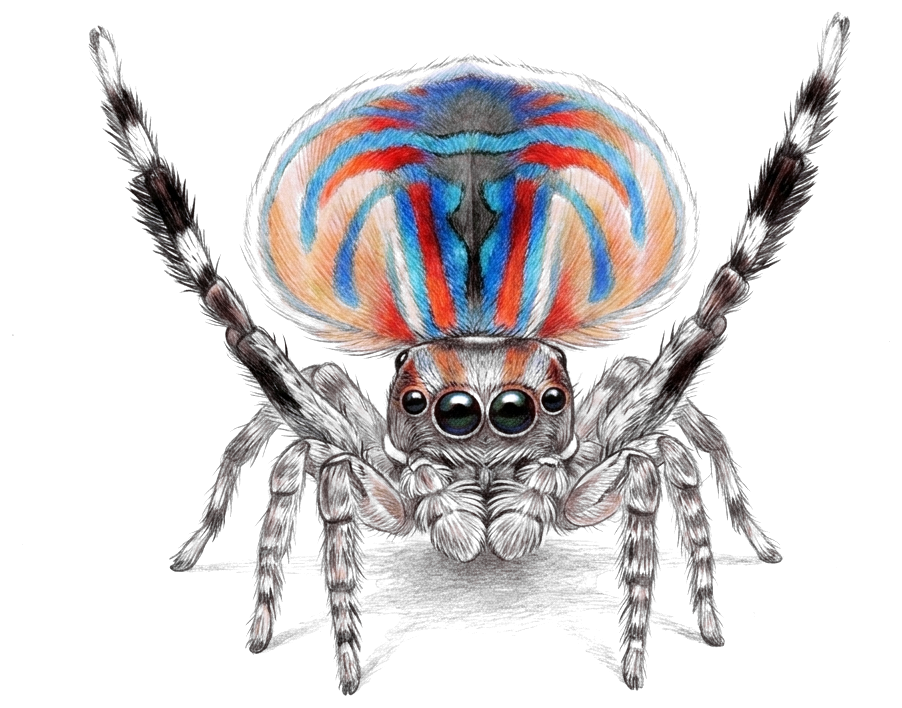
He is a few millimeters long. He raises the flap on his abdomen until it stands open above him, lifts his third pair of legs, and drums.
All of it is aimed at an animal watching from a short distance away, who will decide.
None of that display helps him survive. It costs him. It exists because she looks — which is selection with an eye in it, and the eye is hers.
December 31
Bezouli
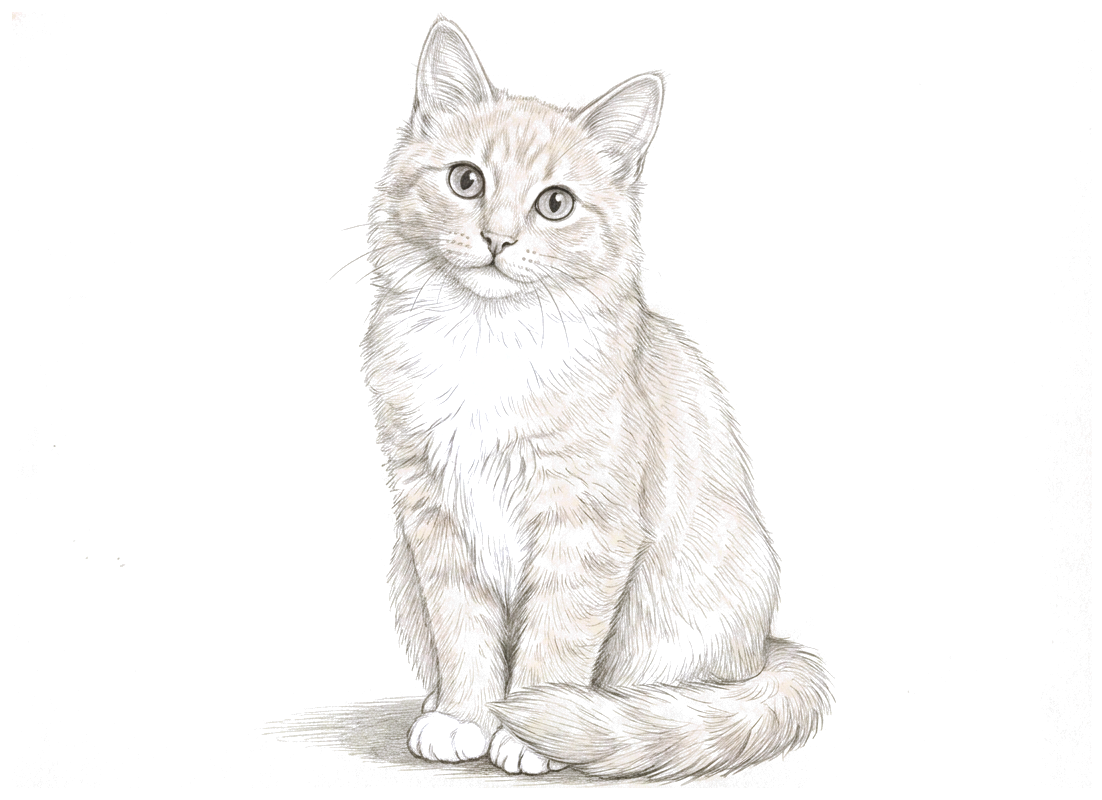
He was a stray on a patio in Greece. He was dying, and on the last night, with nothing left that was medicine, a seventeen-year-old boy fed him.
The next morning he came back with a field mouse in his mouth, put it down, and walked away.
Everything else on this page is a kind of animal. This one had a name. His story is here.